The Fed Cut Its Statement in Half. What It Removed Matters More.

Key Takeaways
- The statement was cut in half. The first two Warsh-chaired statements average 113.5 words, 55% shorter than Powell’s final eight.
- Forward guidance took the hit. All 24 of 24 recurring Powell-era reaction-function and guidance phrases disappeared from both Warsh statements.
- The minutes shift with the economy, not the chair. The rise in supply-shock language barely survives Powell; the Warsh-era minutes devote substantially more attention to AI investment and buildout.
- Markets: suggestive, not causal. Short-end volatility rose temporarily on major information days, consistent with reduced guidance but confounded by the size of the news itself.
The Federal Reserve left its policy rate unchanged at 3.5% to 3.75% at its July meeting, but the decision was hardly unanimous. The vote was 9–3, with Beth Hammack, Neel Kashkari and Lorie Logan preferring a quarter-point increase. The statement described economic activity as solid, pointed to strong productivity and capital investment, and said inflation remained above the Fed’s 2% goal, with supply shocks and energy prices still part of the story.
The minutes released this week add detail to that debate. But the clearest change in the Warsh Fed is not a forecast or a dissent. It is the way the institution communicates.
The FOMC is saying much less. More important, it is no longer saying the same kinds of things.
The statement was cut in half
Powell’s final eight FOMC policy statements averaged 252.4 words. The first two Warsh-chaired statements averaged 113.5. That is a 55% reduction, and the break was immediate: 113 words in June and 114 in July.
That alone is a meaningful change in the Fed’s communications regime. But shorter statements do not necessarily imply less guidance. The Fed could have compressed the same guidance into fewer words. So the more useful question is what disappeared.
What disappeared was the forward guidance
I first identified recurring Powell-era language without using the Warsh statements. The baseline exercise takes Powell’s final eight statements and mechanically finds two- to seven-word expressions appearing in at least six of the eight meetings. That produced 49 recurring phrases. Only after the set was frozen did I check whether those expressions appeared in the first two Warsh-chaired statements.
Forty-two of the 49 — 85.7% — were absent from both.
That broad result tells us the language changed. It does not, by itself, tell us what kind of language changed. To answer that, I classified the 49 phrases by meaning before revealing their Warsh survival outcomes. The taxonomy separated forward guidance language from decision and mandate language, descriptions of economic conditions, and a small residual group that was too ambiguous to classify confidently.
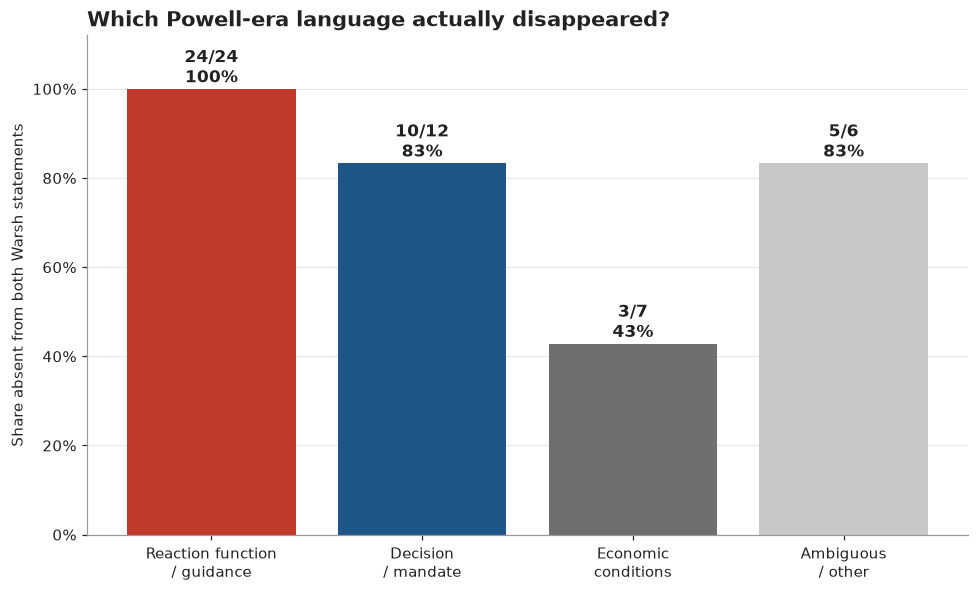
All 24 of 24 recurring phrases classified as reaction-function or guidance language disappeared from both Warsh statements.

By comparison, 10 of 12 decision and mandate phrases disappeared, while only 3 of 7 economic-condition phrases disappeared. Pooling the two clearly substantive non-guidance groups, the disappearance rate was 100% for guidance language versus 68.4% for decision, mandate and economic-condition language — a 31.6 percentage-point gap.
What survived makes the difference intuitive. The Warsh statements retained the basic architecture: “committee decided,” “target range for the federal funds rate,” “economic activity,” “job gains have,” and “unemployment rate.”
What vanished was the recurring language explaining how the Committee would respond to what happens next: assessing the appropriate stance of policy, incoming data, the balance of risks, carefully assessing new information, monitoring implications, considering the extent and timing of adjustments, and being prepared to adjust the stance of policy.
That is the central finding: the Fed did not simply shorten the Powell statement. It disproportionately removed the recurring language that described its reaction function.
The language break survives the obvious robustness tests
There are researcher choices in any text exercise. Why Powell’s final eight statements instead of six or twelve? Why require a phrase to appear in at least three-quarters of the Powell statements?
So I reran the phrase-discovery exercise using Powell lookbacks of 6, 8 and 12 statements and recurrence thresholds of two-thirds, three-quarters and five-sixths. Across all nine specifications, the share of recurring Powell wording absent from both Warsh statements ranges from 84.3% to 90.2%. The 85.7% baseline sits toward the low end of that range.
Then I tested the most obvious mechanical explanation: perhaps a statement that is less than half as long simply has no room for the old phrases.
For the baseline 49-phrase set, I repeatedly shortened Powell statements to match the length of the first two Warsh statements, using the same text-processing rules as in the phrase analysis, and then measured how much recurring Powell-era language disappeared. Across 50,000 length-matched placebo draws, the average disappearance rate was 43.0%. The 95th percentile was 61.2%, the 99th percentile 65.3%, and the most extreme draw reached 77.6%. The actual Warsh result was 85.7%.

None of the 50,000 baseline placebo draws produced a break as large as the one observed. That is not a conventional p-value and it is not a causal experiment. It answers a narrower question: shorter statements alone do not reproduce the observed loss of recurring Powell-era wording.
The minutes show a change in emphasis as the economy changes
The first two Warsh-chaired minutes differ topically from Powell’s final three. A descriptive weighted-log-odds ranking puts words such as AI-related, buildout, investment and spending on the Warsh side, while the recent Powell minutes lean more toward liquidity, risks, adjustments and jobs.

But that comparison is heavily shaped by the economy each Committee was discussing. June and July 2026 came amid a Middle East energy disruption and an AI-capital-spending boom. Those developments naturally bring supply constraints, investment and capital spending closer to the center of the discussion, regardless of who holds the gavel.
The historical comparison makes that clear. In Powell’s March and June 2022 meetings, when the Fed was confronting a major energy and supply shock, supply-related language averaged 7.29 mentions per 1,000 cleaned content tokens. That compares with 4.29 in the first two Warsh meetings and just 0.71 in Powell’s immediately preceding 2026 meetings.

That is a useful null. The increase in supply language under Warsh looks less like a leadership effect than a response to changing economic conditions. Powell’s Fed used even more of that vocabulary when supply shocks were more central to the outlook.
The same caution applies to AI. The Warsh-era minutes devote substantially more attention to AI investment and buildout, but that coincides with the acceleration of the AI-capex cycle itself. There is no clean historical counterfactual for that shift. I therefore treat the AI and investment language as evidence of what is receiving more attention now, not evidence that the leadership change caused that attention.
Financial conditions tell a similar story, with one important wrinkle. The Warsh minutes invoke financial conditions more often than Powell’s immediately preceding 2026 meetings, but not more than Powell’s 2022 supply-shock meetings. The rapid rise in interest rates is what drove the discussion of financial conditions in 2022, and the banking crises of 2023 kept it going.
What does appear new in the recent sample is the emphasis. In July, for the first time in the 2026 meetings we examine, participants explicitly asked whether financial conditions were sufficiently restrictive to return inflation to 2 percent. Earlier references had generally treated financial conditions as part of the backdrop supporting or restraining growth and demand. July brings them more directly into the question of whether overall conditions are tight enough to deliver the inflation objective.
That is how I would read the minutes overall: it’s evidence that the Fed’s emphasis is shifting with the economy in front of it. Supply shocks, AI investment and strong asset prices are becoming more relevant to the policy discussion because those are increasingly important features of the current environment.
The most interesting market pattern shows up on information days
Treasury yields did reprice higher over the period. Using five-observation averages through August 17, the 2-year yield rose about 10 basis points, the 10-year about 9 basis points and the 30-year about 13 basis points. Curve shape changed little: 2s10s flattened by 1 basis point and 2s30s steepened by 3, implying only about 4 basis points of additional 10s30s steepening.
The volatility result is more nuanced than “volatility did not rise.” In the first 20 trading days after the handover, 2-year realized volatility was about 27% higher than in the matched pre-handover window. Over 40 days it was about 21% higher. Yet 10- and 30-year volatility fell in both windows.
The short-end increase is concentrated on major information days. Once CPI releases, payroll reports and FOMC decision days are excluded, the 20-day increase disappears and the 40-day comparison is essentially flat. Over the full 58-day window, 2-year volatility is roughly unchanged with all days included and lower when those event days are removed; 10- and 30-year volatility are lower either way.
That pattern is consistent with one implication of reduced forward guidance: if the Fed pre-commits less to a path, incoming information may do more of the work in moving near-term rate expectations, and the effect should show up most clearly at the short end when news arrives.
But this is not yet a test of that mechanism. Summer 2026 may simply have produced bigger surprises — including the oil shock, inflation news and labor-market data. To distinguish “markets react more to the same-sized surprise” from “the surprises were larger,” we would need a surprise-scaled event study that compares the 2-year yield response to a standardized unit of macroeconomic news before and after the communication change.
For now, the market evidence is suggestive, not causal. The short end became temporarily more volatile on information days, exactly where a reduced-guidance channel could operate, but the size of the news itself remains a confound.
The takeaway
Two meetings into the Warsh Fed, the strongest result is not that the central bank uses fewer words. It is what those fewer words omit.
The FOMC statement is 55% shorter than under Powell. Overall Powell-era wording disappearance remains between 84% and 90% across reasonable alternative specifications, and shortening Powell statements alone cannot reproduce the baseline break.
More important, every recurring Powell-era phrase we classified as reaction-function or forward guidance language disappeared from both Warsh statements, while basic descriptions of the economy and the policy decision survived much more often.
The market evidence is similarly careful. Short-end volatility rose temporarily on information days, a pattern consistent with less forward guidance but not yet separable from larger economic surprises.
The Fed’s communication regime has changed sharply, and the change is concentrated in the language that used to tell markets how the Committee would respond to what comes next.
Appendix: How we did it
A. Policy-statement sample
The data comes from the FOMC meeting statements and minutes on the Federal Reserve’s website.
The baseline Powell comparison contains the final eight validated statements before the May 22, 2026 leadership handover: June 18, July 30, September 17, October 29 and December 10, 2025; and January 28, March 18 and April 29, 2026. The post-handover comparison is June 17 and July 29, 2026.
The robustness universe extends the Powell sample to the final 12 statements, beginning December 18, 2024. Statement text excludes release headers, voting paragraphs, implementation notes and media-contact boilerplate.
B. Recurring Powell-era wording
The baseline phrase set is discovered using Powell text only. The procedure generates punctuation-aware two- through seven-word expressions within clauses, normalizes possessives, removes clearly incomplete constructions and consolidates nested or near-duplicate expressions. A phrase qualifies if it appears in at least six of Powell’s final eight statements.
The Warsh statements are not used to select the baseline phrase set. The final baseline contains 49 recurring Powell-era expressions. Once frozen, the phrases are evaluated against the first two Warsh-chaired statements. Forty-two are absent from both.
C. Outcome-blinded semantic taxonomy
To determine what kind of Powell-era language disappeared, the 49 phrases were classified by meaning before Warsh survival outcomes were revealed in that stage of the analysis. The taxonomy was not preregistered and the broader project had already observed the aggregate carryover result, so this is best described as an outcome-blinded semantic robustness exercise rather than a fully ex ante test.
The frozen categories contain 24 reaction-function and guidance phrases, 12 decision and mandate phrases, 7 economic-condition phrases and 6 phrases left as ambiguous or other. After the taxonomy was frozen, the Warsh outcomes were revealed.
All 24 reaction-function and guidance phrases were absent from both Warsh statements. Ten of 12 decision and mandate phrases and three of seven economic-condition phrases were absent. The primary comparison is therefore 24 of 24 guidance phrases absent versus 13 of 19 other clearly classifiable substantive phrases absent, a 31.6 percentage-point difference in disappearance rates.
A two-sided Fisher exact diagnostic yields p = 0.0045, but we do not use that as the basis for the claim because phrases are not guaranteed to be statistically independent observations. The raw category shares are the primary evidence.
D. Specification sensitivity
To address researcher discretion, we reran the phrase-discovery exercise over Powell lookback windows of 6, 8 and 12 statements and recurrence thresholds of two-thirds, three-quarters and five-sixths. Across the resulting nine specifications, the share of Powell-derived expressions absent from both Warsh statements ranges from 84.3% to 90.2%.
E. Length-matched placebo
The length placebo is run on the baseline 49-phrase set only. Each of 50,000 simulations selects two different Powell statements and draws contiguous excerpts matching the tokenizer lengths of the first two Warsh statements. The statistic is the share of baseline recurring Powell phrases absent from both excerpts.
The placebo distribution has a mean of 43.0%, a 95th percentile of 61.2%, a 99th percentile of 65.3% and a maximum of 77.6%. The observed Warsh result is 85.7%. No baseline placebo draw reaches the observed value. This is a descriptive length sensitivity test, not a conventional p-value or a causal experiment.
F. Minutes-language analysis and topic benchmark
The primary minutes comparison uses Powell’s January 28, March 18 and April 29, 2026 meetings and the first two Warsh-chaired meetings on June 17 and July 29, 2026. Weighted log odds with a pooled-corpus informative prior are used as a descriptive ranking device only. With five documents, the meeting — not each token — is the relevant independent unit, so the scores should not be read as conventional significance tests.
Document presence is retained to distinguish terms that recur across both Warsh meetings from one-meeting spikes. The recent 3-vs-2 comparison is explicitly treated as topic-confounded.
For a supply-shock benchmark, we add Powell’s March and June 2022 minutes. Supply mentions average 0.71 per 1,000 cleaned content tokens in Powell’s January–April 2026 meetings, 4.29 in the Warsh June–July 2026 meetings, and 7.29 in the Powell 2022 supply-shock meetings. Because the Powell benchmark exceeds the Warsh rate, the 2026 supply-language difference cannot be cleanly attributed to leadership.
AI and buildout language are not benchmarked against a clean historical counterfactual because 2022 predates the current AI-capex cycle. Those differences are therefore treated as descriptive.
We also add a financial-conditions theme, measured within the participants’ discussion sections and validated at the sentence level. Financial-conditions mentions average 0.77 per 1,000 participant words in Powell’s recent 2026 meetings, 1.61 in the Warsh meetings, and 2.06 in the Powell 2022 supply-shock meetings; because the Powell 2022 rate is highest, the concept is not uniquely Warsh. For each mention we flag whether it frames financial conditions as a growth backdrop or as a policy-sufficiency question. Only the July 2026 meeting explicitly asks whether conditions are sufficiently restrictive to return inflation to 2 percent, and Powell’s 2022 minutes also link financial conditions to price stability.
G. Treasury-market analysis
Treasury data are the FRED constant-maturity series DGS2, DGS10 and DGS30, with the market sample locked through August 17, 2026. May 22 is treated as the final pre-handover observation because the leadership announcement occurred after that day’s Treasury constant-maturity observation.
Realized volatility is the sample standard deviation of daily basis-point yield changes. We compare matched, non-overlapping pre and post windows of 20, 40 and 58 trading days. Each comparison is repeated after excluding scheduled CPI release days, Employment Situation release days and FOMC policy-decision days.
In all-days samples, 2-year volatility rises 27% over 20 days and 21% over 40 days, then is essentially unchanged over 58 days. After major scheduled event days are removed, the 20-day comparison is lower, the 40-day comparison is approximately flat and the 58-day comparison is lower. Ten- and 30-year volatility decline in every specification.
Yield-level and curve comparisons use five-observation averages ending May 22 and August 17. The 2-year rises about 10 basis points, the 10-year about 9 and the 30-year about 13. The 2s10s spread changes by −1 basis point and 2s30s by +3 basis points. We treat 2s30s as a curve measure, not a direct term-premium measure.
The event-day concentration of 2-year volatility is consistent with a reduced-guidance mechanism but does not identify it. A stronger test would scale yield moves by the size of CPI, payroll and other macro surprises and compare the response coefficient before and after the communication change.
Sources and methods
Federal Reserve FOMC policy statements and minutes through July 29, 2026.
Federal Reserve FOMC calendar and meeting pages used to validate policy statements.
Federal Reserve Bank of St. Louis FRED: DGS2, DGS10 and DGS30, market data through August 17, 2026.
Bureau of Labor Statistics release calendars for CPI and the Employment Situation.
Monroe, Burt L., Michael P. Colaresi, and Kevin M. Quinn (2008), “Fightin’ Words: Lexical Feature Selection and Evaluation for Identifying the Content of Political Conflict,” Political Analysis 16(4): 372–403.