September Inflation Came in Too Hot, and Rates Jumped. Here’s Why The Fed Can Wait.

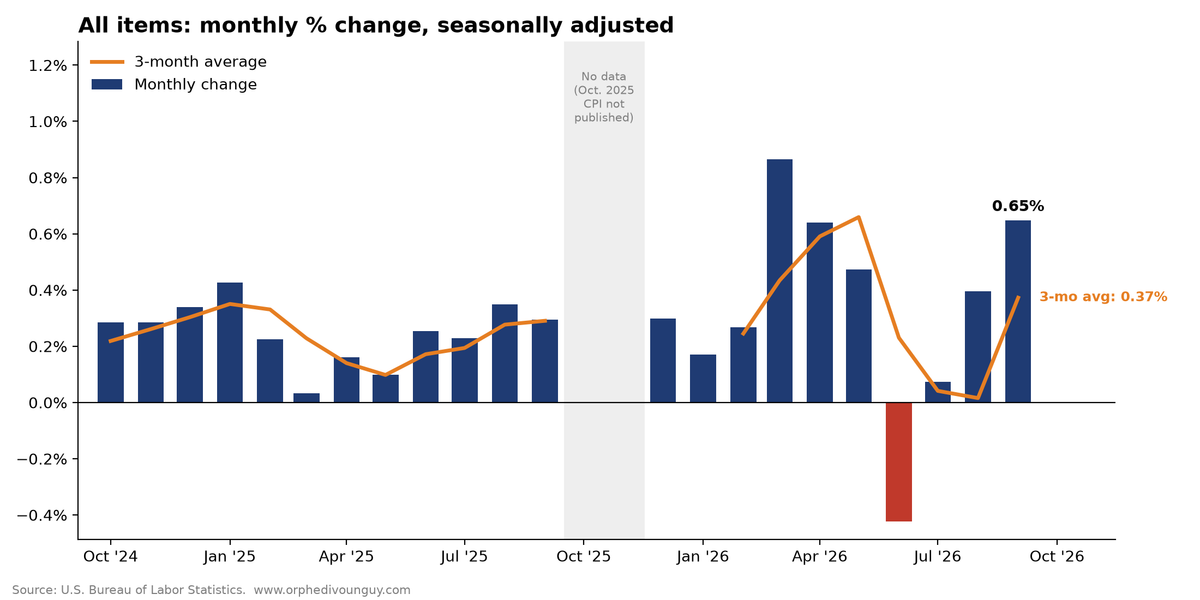
Gasoline drove the headline, but core prices came in hotter than forecast. Bond yields rose after the report. Still, the pressure is mostly fuel, so the Fed can wait.
Key Takeaways
- Core ran hotter than forecast. Prices excluding food and energy rose 0.3% in September, above the 0.2% expected, and at a 3.4% annual pace over the past three months.
- The oil shock is reaching services. Core services are running at a 3.8% three-month pace, led by transportation; airfares are up 22.4% over the year.
- Rates jumped. The 2-year Treasury yield rose about 13 basis points, and the odds of an October hike more than doubled to 47.1%.
- The Fed can wait. The hotter prices are mostly fuel-linked, while rent, medical services and restaurant meals are steady.
What happened
Consumer prices rose 0.6% in September, as forecast, lifting annual inflation to 3.7% from 3.4%, a notch above the 3.6% expected. Gasoline rose 9.1% and made up more than half of the increase.
The surprise was core inflation, which excludes food and energy. It rose 0.3%, above the 0.2% forecast, and 2.6% over the year. Over the past three months, core prices have risen at a 3.4% annual pace.

Energy drove most of the headline increase. Higher oil costs may also be feeding into other prices, particularly airfares.
The bigger concern is core services, which rose at a 3.8% annual pace over the past three months, above their 3.1% annual rate. The pickup is concentrated in transportation, where higher fuel costs are feeding into fares and fees. Airfares are up 22.4% over the year. Rent and medical services, the largest parts of core services, are steady. Food prices are cooling.
Core services inflation was cooling before the war. The oil shock interrupted that progress as higher fuel and transportation costs work their way into consumer prices.
That is why the Fed can wait. Most of the prices running hotter are tied to fuel: gasoline, heating oil, airfares and transportation services. Vehicles are the exception. Used car prices have risen at a 5.9% annual pace over the past three months, and new car prices are firming too. The prices that usually signal an overheating economy, such as rent, homeowners’ housing costs, medical services and restaurant meals, are holding steady. As long as longer-term inflation expectations stay anchored, raising rates would squeeze demand without touching the source of the pressure.

The market reaction
Mortgage rates had fallen for three consecutive trading days before the report. In early trading after the release, the 2-year Treasury yield rose about 13 basis points, the 10-year about 9 and the 30-year about 5. According to CME FedWatch, the probability of an October rate hike more than doubled, from 22.1% yesterday to 47.1% this morning.
The pattern was consistent with my research on how data moves rates. On CPI days, the 10-year has moved about 0.7 basis points for every basis point in the 2-year. The early reported moves had a similar ratio, although those intraday figures are not directly comparable with my daily end-of-day estimates.
Applying my historical CPI-day estimates to a sustained 13-basis-point increase in the 2-year yield suggests roughly a 6–9-basis-point rise in mortgage rates. Using Mortgage News Daily’s 7.46% reading yesterday as a baseline, that would imply a move up in mortgage rates to roughly 7.52%–7.55%.
What it means
Households are squeezed from both sides. Wage growth slowed to 3.0% over the past year while prices rose 3.7%. Gasoline is up a third, and heating oil is up nearly three-quarters as winter approaches. Now borrowing costs are climbing too.
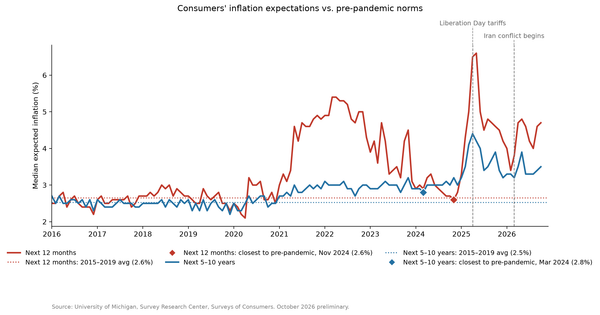
For the Fed, which raised rates in September and meets again Oct. 27–28, the case for another hike is real. Core momentum has picked up, and year-ahead inflation expectations have risen to 4.7% in Michigan’s survey.
Beyond the October meeting, a core reading of 0.4% or more in next month’s report, spread across goods and services, or a sustained rise in longer-term inflation expectations would strengthen the case for another hike. Next month’s CPI report will be released November 10, after the October 27–28 Fed meeting.
For now, the Fed should hold and watch the spillover.
Sources. BLS, Consumer Price Index, September 2026 (October 14), and Employment Situation, September 2026 (October 2). Forecasts: Dow Jones via CNBC. Early Treasury moves: CNBC and market reporting; intraday snapshots vary. Hike probabilities: CME FedWatch, October 13 and October 14 morning snapshot. Mortgage baseline: Mortgage News Daily, October 13. Mortgage estimates: author’s historical CPI-day calculations. Inflation expectations: University of Michigan, preliminary October survey.