You've Got Mail: The Federal Government Is Already Sending You the Bill

Key Takeaways
- Government borrowing is not free. Persistent deficits eventually require some combination of higher future revenues, lower spending, faster growth or erosion of the real value of nominal debt through inflation. Along the way, heavier borrowing can also put upward pressure on interest rates.
- Net interest was the largest single driver of the increase in federal spending through June, accounting for nearly half of the net increase.
- As interest claims more of the budget, less room is left for everything else — education, income security, and other functions have all lost ground.
- The Fed can’t simply cut rates to fix this. Lowering rates to ease the government’s debt bill (fiscal dominance) risks higher, more volatile inflation — and inflation only lightens old fixed-rate debt once, since new borrowing then costs more.
- When growth exceeds the effective interest rate, the existing debt stock becomes easier to carry relative to the economy. But continued primary deficits can still push the debt ratio higher.
Federal deficits can feel abstract. A trillion dollars is too large to picture, and the connection between Washington’s budget and a family trying to buy a house is easy to miss.
But somebody eventually pays for government borrowing. The bill always arrives. The only real question is how it is addressed to us.
When the federal government spends more than it collects, the Treasury borrows the difference. More borrowing can put upward pressure on interest rates as the government competes with households and businesses for the same pool of savings.
That relationship is not automatic.
If households and investors believe today’s additional debt will eventually be backed by higher taxes or lower spending, they can respond by saving more today. That is the logic behind Ricardian equivalence: government borrowing can, under certain conditions, simply shift taxes from today into the future rather than dramatically increasing the demand for capital. Robert Barro formalized the modern version of the idea decades ago. But the empirical evidence suggests private saving generally does not offset government borrowing dollar for dollar.
So fiscal credibility matters. If investors believe Washington will eventually stabilize the debt, the effect of additional borrowing on interest rates can be smaller. If deficits are expected to persist without enough future taxes or spending restraint to back the debt, the adjustment has to happen somewhere else.
We can pay through higher taxes.
We can pay through higher interest rates, as government borrowing absorbs more of the available savings.
Or we can pay through higher inflation — effectively another tax on purchasing power, and one that lands hardest on lower-income households, who spend far more of their income on necessities like food, housing, transportation and energy. In a 2022 speech, Federal Reserve Governor Lael Brainard cited calculations showing that lower-income households spend about 77% of their income on necessities, compared with 31% for higher-income households. That leaves them the most exposed when prices rise.
There is no free option.
The research supports the connection between deficits and borrowing costs. Federal Reserve economist Thomas Laubach estimated that a one-percentage-point increase in the projected federal deficit relative to GDP raises long-term interest rates by roughly 25 basis points. His design also tested the Ricardian argument directly: if deficits merely reflect a change in the timing of taxes, with no additional government purchases, rates should be unaffected. His results suggest the real-world offset is far from complete.
There is an inflation channel too. Francesco Bianchi, Renato Faccini and Leonardo Melosi show how fiscal shocks can generate persistent inflation when new government debt is not expected to be fully backed by future fiscal adjustments. In that environment, inflation helps erode the real value of outstanding nominal debt.
None of this means every dollar Washington borrows automatically raises your mortgage rate or the price of groceries. Private saving matters. Global demand for Treasuries matters. Monetary policy matters. Growth matters too.
Debt is easier to carry when the economy grows faster than the effective interest rate paid on that debt. When growth outpaces the borrowing cost, an existing stock of debt can shrink relative to the economy even without being paid down. Olivier Blanchard has emphasized how much this interest-growth differential matters for debt sustainability. But as borrowing costs rise relative to growth, the arithmetic becomes less forgiving: stabilizing the debt eventually requires smaller primary deficits — and, once borrowing costs exceed growth, stabilizing the debt ratio requires a primary surplus, all else equal.
Persistent deficits do not disappear. Eventually the debt must be backed by future taxes, spending restraint, faster growth — or some erosion of its real value through inflation.
And that makes what is happening inside the federal budget increasingly important.
So Where Is the Money Going?
Through June, the first nine months of fiscal year 2026, the federal government spent roughly $5.52 trillion while collecting about $4.15 trillion. That left a deficit of approximately $1.37 trillion.
Compared with the same period last year, revenue rose about $143 billion, or 3.6%. But spending rose by even more — roughly $172 billion, or 3.2%. The deficit therefore widened by about $29 billion.
So what drove the increase in spending?
The largest contributor was not defense.
It was not Medicare.
It was not Social Security.
It was interest on the debt.
Net interest spending increased by roughly $78 billion from the same period last year — nearly half of the entire net increase in federal spending. Social Security added another $63 billion. Medicare rose about $57 billion, health spending about $47 billion and national defense about $31 billion. Meanwhile, spending across all remaining categories collectively fell by roughly $103 billion, partially offsetting those increases.

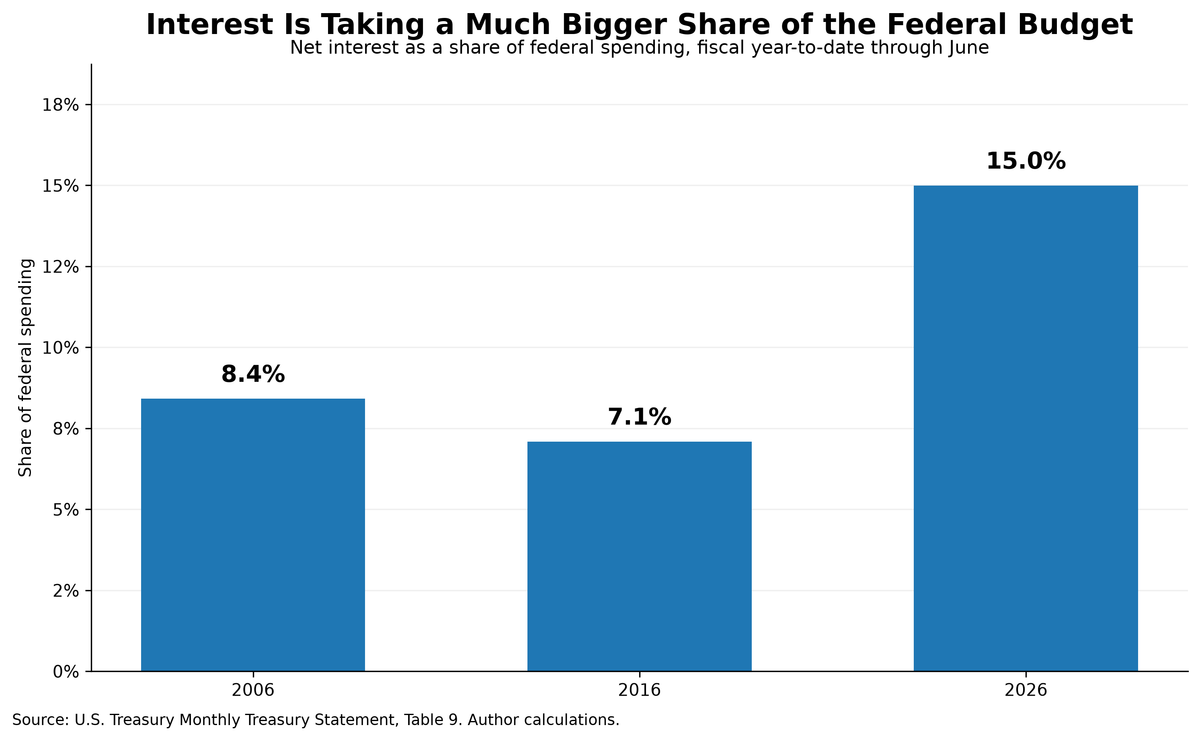
The composition of the federal budget is changing. Through June, Social Security accounted for about 22.5% of federal spending. Net interest was already second, at roughly 15% — ahead of Medicare at 14.1%, health programs at 13.8% and national defense at 12.9%.
Twenty years ago, interest was not among the five largest federal spending functions. Ten years ago, it still was not. In 2006, Social Security and defense dominated the budget. In 2016, Social Security remained first, followed by defense, Medicare, income security and health.


Through June, the federal government spent more on net interest than on national defense.
Interest Is Taking Up More Room
The squeeze is beginning to show elsewhere in the budget. Compared with the same period last year, net interest increased its share of total federal spending by roughly one full percentage point. At the same time, several other functions lost ground: education, training, employment and social services fell by 1.11 percentage points; income security by 0.52; natural resources and environment by 0.51; community and regional development by 0.43; and international affairs by another 0.23.

This does not mean rising interest costs directly caused those declines. Individual categories can move sharply for many reasons — policy changes, credit-program accounting, expiring programs, the timing of payments. A shrinking share is not proof that interest crowded a particular program out.
But this is what a fiscal squeeze looks like. All else equal, as more of the budget goes to servicing debt accumulated in the past, less room remains for everything else. Every dollar spent on interest cannot simultaneously fund education, infrastructure, defense, tax relief or any other priority. Unlike primary spending, interest payments finance no current government program or investment; they are payments on debt issued to finance past deficits.
So Why Can’t the Fed Just Cut Interest Rates?
At first glance, there seems to be an easy solution. If high rates are making the government’s debt expensive, why not simply have the Federal Reserve cut them?
Because that would not eliminate the bill. It would only change how we pay it.
The Federal Reserve’s job is to maintain price stability and maximum employment — not to minimize the Treasury’s borrowing costs. If the Fed deliberately held rates below the level needed to control inflation because the government had borrowed too much, monetary policy would effectively become subordinate to fiscal policy. Economists call this fiscal dominance, and Federal Reserve research shows why it is dangerous: when monetary policy starts responding to the government’s financing needs rather than to inflation and the economy, inflation itself becomes far more volatile. That is not an argument against cutting rates when the inflation and employment outlook warrants it; it is an argument against setting monetary policy to manage the Treasury’s interest bill.
Cutting rates aggressively to shrink Washington’s interest bill would stimulate borrowing and demand. If inflationary pressure remained, that could reignite or prolong it. And if investors came to believe the Fed was tolerating higher inflation to make the debt easier to finance, they would demand more compensation for inflation risk on long-term Treasuries. So even cutting short-term rates might not sustainably lower the government’s long-term borrowing costs.
Inflation would do one thing for the Treasury: reduce the real value of the fixed-rate debt already outstanding. But the benefit does not last. The Treasury refinances its debt over time, and once investors expect higher inflation, they demand higher nominal yields on newly issued securities. Surprise inflation can lighten the real burden of yesterday’s debt. Persistent, expected inflation just raises the cost of financing tomorrow’s.
And Americans would still pay for whatever relief inflation did provide. Prices would rise relative to the value of money. Savings would lose purchasing power. And the families already spending most of their income on food, rent, transportation and energy would carry the heaviest burden — the same households least able to absorb it.
So the choice is not between today’s high interest expense and a painless rate cut. The real choice is whether elected officials eventually bring spending and revenue onto a sustainable path — or whether some combination of higher taxes, higher borrowing costs and inflation makes the adjustment for them.
The federal debt is often described as a bill we are leaving to our children. But higher interest costs are already squeezing today’s budget. Higher borrowing costs already reach households and businesses. And inflation, when fiscal and monetary discipline slip, is a tax families feel every time they buy groceries, fill the tank or pay the rent.
The bill is not coming someday.
You already have mail. We are already paying it.
Federal spending and revenue figures are the author’s calculations from the U.S. Treasury’s Monthly Treasury Statement (Table 9), fiscal year 2026 year-to-date through June, compared with the same period in fiscal 2025. The 77%/31% necessities figures are from Federal Reserve Governor Lael Brainard’s April 2022 remarks on the inflation experiences of households.