September 2026 Jobs Report: Still Low Hire, Low Fire

Key Takeaways
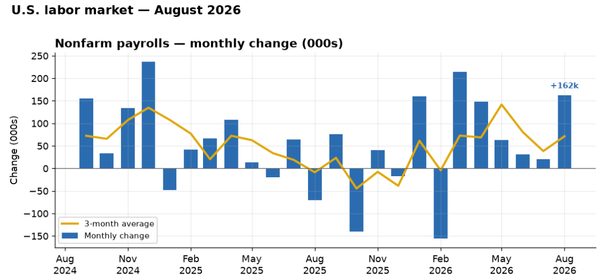
- Employers added 29,000 jobs in September. That looks soft in isolation, but the broader pattern hasn’t changed much. Not-seasonally-adjusted payroll employment has increased by roughly 2.5 million from January through September this year, compared with about 2.3 million over the same period last year.
- The three-month average of seasonally adjusted payroll gains is 51,000 per month. Given slower population and labor-force growth, that’s roughly within current estimates of the breakeven pace needed to keep unemployment from rising substantially.
- This remains a low-hire, low-fire labor market. Successive shocks have given businesses reasons to wait before expanding, while AI is changing hiring decisions in parts of professional services.
- Labor supply is slowing too. Lower immigration means fewer workers are entering the economy, reducing both labor-force growth and the number of jobs needed each month to maintain a stable unemployment rate.
- Worker flows improved in September. The direct CPS flows show that an unemployed worker was more likely to find a job than to leave the labor force. But both the direct flows and a broader job-finding measure show that finding work remains harder than it was in 2018–19.
September looks a lot like more of the same
Employers added 29,000 jobs in September.
Previous estimates were also revised lower. August’s gain was revised from 162,000 to 133,000, while July was revised from a gain of 21,000 to a loss of 10,000. The three-month average is now 51,000 jobs per month, compared with 66,000 over the past six months.
But I don’t think the right conclusion is that the labor market suddenly weakened in September.
Step away from the seasonally adjusted monthly numbers and the broader picture looks remarkably familiar. From January through September, not-seasonally-adjusted payroll employment increased by roughly 2.5 million jobs. Over the same period in 2025, employment increased by roughly 2.3 million.
September is another month in a labor market that has been sluggish for quite some time.
Still low hire, low fire
The defining feature of this labor market isn’t mass layoffs.
It’s caution.
Businesses have faced one shock after another. Tariff changes created uncertainty about costs and supply chains. Then the Iran war and oil-price shock created another source of uncertainty about energy costs, inflation and interest rates.
When the outlook becomes harder to predict, businesses have an incentive to wait. A company doesn’t necessarily respond by firing workers. It can postpone opening another location, delay an investment, leave an open position unfilled or decide not to create a new position in the first place.
AI adds another layer, particularly in professional and business services.
Companies are spending heavily on new tools while simultaneously trying to determine what those tools mean for staffing. Some tasks can be automated. Others can be done by existing employees more efficiently. And entirely new jobs may eventually emerge.
But while businesses figure out where AI actually raises productivity, there is less reason to rush into expanding headcount.
The result isn’t necessarily large-scale job destruction. It can simply mean fewer new jobs.
Breadth improved slightly
That’s also why the industry data matter.
Six of the 11 major sectors added jobs in September. Private education and health services added 20,000 jobs. Trade, transportation and utilities added 18,000. Construction added 11,000, leisure and hospitality added 10,000, manufacturing added 9,000 and other services added 6,000.
Government employment fell by 17,000. Information lost 10,000 jobs, professional and business services lost 9,000, financial activities lost 7,000 and mining and logging lost 2,000.
The latest employment diffusion data tell a similar story. The one-month diffusion index for total private employment was 68.6 in August. A reading above 50 means more industries were adding workers than cutting them.
Labor supply is slowing too
There’s another side to this story that is easy to miss.
Businesses are creating fewer jobs, but the supply of workers is also growing more slowly. Immigration has declined sharply. Because immigrants account for an important share of growth in the working-age population and labor force, lower immigration means fewer new workers entering the labor market.
That matters enormously when interpreting payroll growth.
An economy with rapid population and labor-force growth might need well over 100,000 new jobs each month just to keep unemployment stable. An economy with much slower labor-force growth needs far fewer.
Recent Federal Reserve estimates of today’s breakeven employment growth vary considerably because immigration and population growth are unusually difficult to estimate. A recent St. Louis Fed analysis put the plausible 2026 range at roughly 15,000 to 87,000 jobs per month.
That puts the recent three-month average of 51,000 jobs within current estimates of breakeven.
So slower job creation doesn’t automatically mean the labor market is contracting.
Part of what we’re seeing is slower labor demand. Part of it is slower labor supply.
Finding a job is still hard but fewer workers gave up in September
The worker flows are where the low-hire, low-fire story becomes clearest.
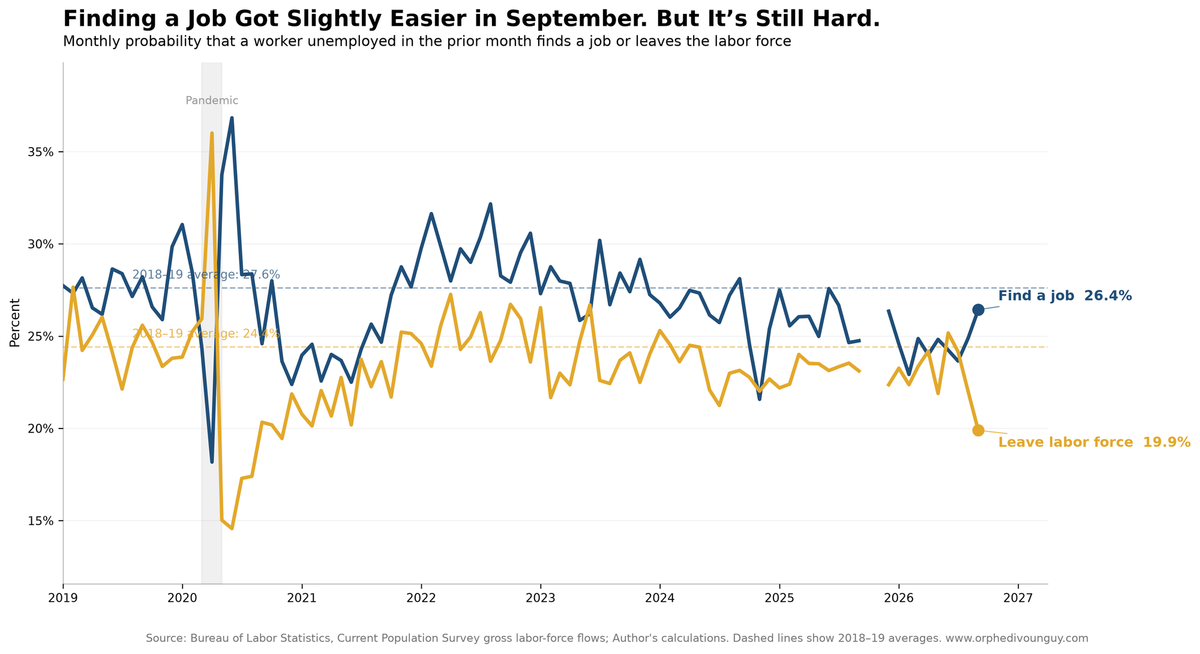
Start with the direct matched-person flows from the Current Population Survey.
In September, an unemployed worker had about a 26% chance of being employed the following month. That’s up from about 25% a year ago and 25% in August.
At the same time, the probability that an unemployed worker left the labor force fell to about 20%, from 23% a year ago.
That’s an improvement.
In June, an unemployed worker had about a 24% chance of finding a job and a 25% chance of leaving the labor force. In July, the two probabilities were again very close: roughly 24% found jobs and 24% left the labor force. By September, they had separated again in the healthier direction.
But we’re not back to normal.
In 2018 and 2019, an unemployed worker had an average 28% chance of finding a job in a given month. September’s 26% is still below that benchmark.
And another number is worth watching: 54% of unemployed workers remained unemployed in September. Before the pandemic, the 2018–19 average was 48%.
Workers are staying unemployed longer. Getting stuck out of a job is considerably more common than it was before the pandemic.
A second measure tells the same basic story
There is another way to measure job finding.
Following Robert Shimer’s approach, we can infer the probability of finding a job from aggregate unemployment and short-duration unemployment. This isn’t identical to the direct matched-person flows above. It accounts differently for movements within the month and rests on stronger assumptions.
By that measure, an unemployed worker had about a 29% probability of finding a job in September.
That’s up from 27% a year ago and 27% in August.
But the comparison with the pre-pandemic labor market is striking: the job-finding probability averaged about 35% in 2018 and 2019.
So September improved slightly. But the probability of finding work remains about 6 percentage points below its 2018–19 average.
Why 29% here but 26% above? They’re different measures. The 26% is the direct, matched-survey probability that someone unemployed last month is employed this month. The 29% is inferred from unemployment stocks and short-duration unemployment. Both point in the same direction: job finding improved slightly in September, but finding work remains harder than it was before the pandemic.
And then there’s the other half of the story.
The Shimer employment-exit probability was just 1.5% in September, compared with 1.6% a year ago and a 1.7% average in 2018–19.
That’s low fire.
Put the two together and the unusual nature of this labor market becomes clearer. If you have a job, you’re relatively unlikely to lose it. If you don’t have one, finding one remains considerably harder than it was before the pandemic.
More people came looking for work
The household survey also helps explain why unemployment rose despite better job-finding flows.
The labor force increased by roughly 485,000 people in September, and the labor-force participation rate rose two-tenths of a percentage point to 61.8%.
Some of those new entrants found jobs. Others didn’t.
The unemployment rate consequently edged up from 4.1% to 4.2%.
That’s very different from unemployment rising because hundreds of thousands of existing workers suddenly lost their jobs.
In fact, about 1.45 million employed workers moved into unemployment in September, down 59,000 from August and roughly 287,000 fewer than a year earlier.
But the increase in the labor force also illustrates the constraint created by a low-hiring economy. When job creation is running close to breakeven, even a temporary increase in the number of people looking for work can push unemployment higher.
Long-term unemployment remains the risk
Long-term unemployment didn’t deteriorate materially in September.
The number of people unemployed for 27 weeks or longer increased by about 14,000 to 1.94 million. That’s essentially unchanged for the month.
But this remains the part of the labor market I’m watching most closely.
A low-fire labor market protects people who already have jobs. A low-hire labor market can be much harder on someone who loses one.
If hiring remains subdued, unemployment spells can lengthen even without a recession or a large wave of layoffs.
That’s why the worker flows matter. September’s small improvement is encouraging. The direct job-finding probability rose slightly. The Shimer job-finding probability rose. And fewer employed workers moved into unemployment. But one month isn’t enough to establish a trend.
Wage growth continues to cool
Average hourly earnings increased by five cents in September to $37.81. Wages are up 3.0% from a year ago.
That is also consistent with a low-hire labor market.
When employers aren’t competing aggressively for additional workers, workers receive fewer outside offers. Wage growth cools and quits decline.
Again, none of that requires widespread layoffs.
Bottom Line
September didn’t fundamentally change the labor-market story. We’re still in a low-hire, low-fire economy.
Businesses have spent much of the past two years navigating one source of uncertainty after another. Tariffs complicated cost and investment decisions. The Iran war and oil shock added another source of uncertainty. AI is forcing businesses, particularly in professional services, to reconsider how much labor they need and what kinds of workers they need.
Those forces are restraining labor demand.
At the same time, lower immigration is slowing growth in the labor force, restraining labor supply and lowering the number of new jobs the economy needs each month simply to keep unemployment stable.
That’s why a payroll gain of 29,000 shouldn’t automatically be read as evidence that the labor market suddenly fell apart.
Through September, not-seasonally-adjusted employment growth looks remarkably similar to the same period last year. The recent seasonally adjusted pace is within current estimates of breakeven employment growth. Employment losses remain contained.
And underneath the small September payroll gain, the worker flows actually moved in the right direction: unemployed workers were more likely to find jobs than they had been a year ago, less likely to leave the labor force, and employed workers remained unlikely to fall into unemployment.
But the pre-pandemic comparison keeps the improvement in perspective. The probability of finding a job remains well below its 2018–19 norm, while unemployed workers are substantially more likely to remain unemployed.
The labor market isn’t booming. It isn’t collapsing either.