Oil Is Keeping Inflation High. But Inflation Isn't Accelerating.

Key Takeaways
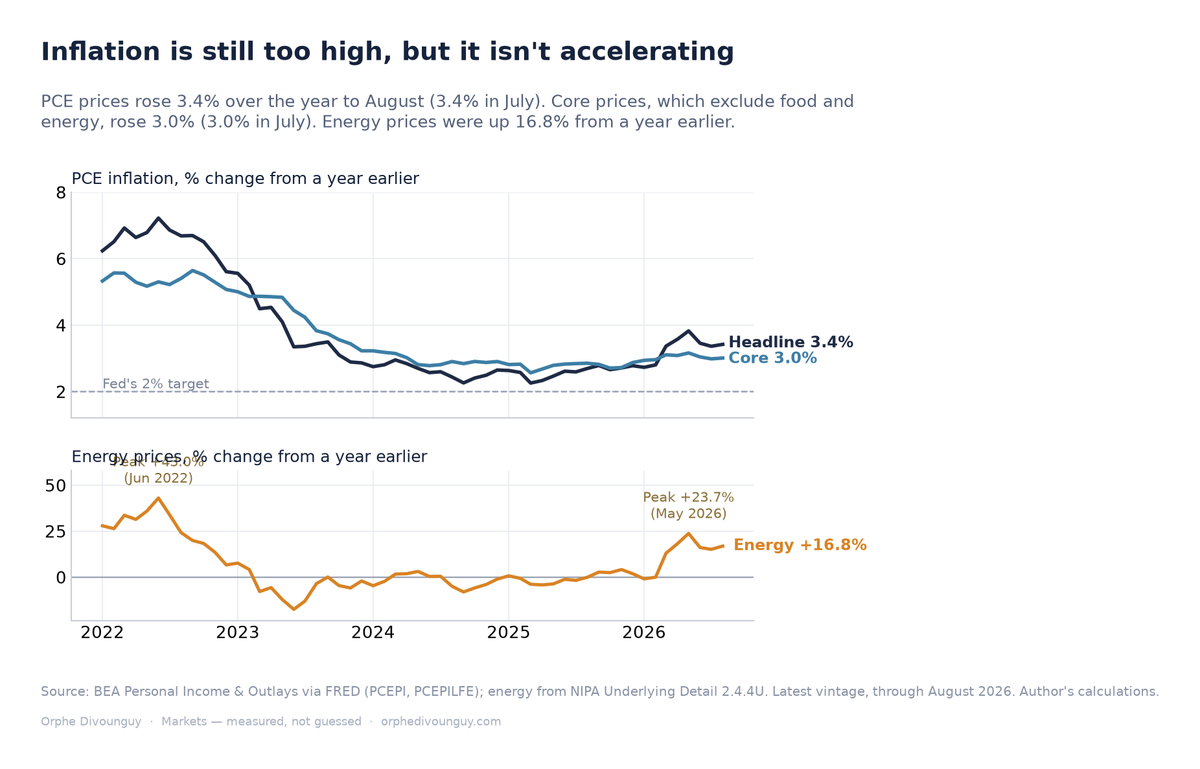
- Inflation is still high, but it isn’t accelerating. Headline PCE inflation held at about 3.4% in August and core inflation held at about 3.0%. Prices are still rising, but they aren’t rising any faster than before.
- Oil is still working its way through the economy. Energy prices were 16.9% higher than a year ago, while inflation excluding energy was 2.9%. When energy prices fell earlier this summer, inflation eased with them. Energy prices rose again in August, helping push monthly inflation back to 0.3%. Some of the earlier oil shock may also be passing gradually into transportation and other energy-intensive prices, but there is little evidence yet of a broader, self-sustaining inflation cycle.
- Consumers are spending faster than their incomes are growing. Real spending rose 2.6% over the past year compared with 1.3% growth in real disposable income, and the saving rate fell to 4.1% in August. JPMorganChase Institute data suggest investment wealth is increasingly one way households are financing the gap.
Inflation is still too high. But it isn’t accelerating.
The PCE price index rose 0.3% in August and was 3.4% higher than a year ago. Core inflation, which excludes food and energy, was 3.0%. Both annual rates were essentially unchanged from July after revisions.
Those revisions matter. Inflation was lower, and saving higher, than first reported. July headline inflation was originally reported at 3.7% and core inflation at 3.3%. The BEA’s annual update revised those figures to about 3.4% and 3.0%, respectively. The July personal saving rate was revised from 3.0% to 4.6%.
That last revision changes the picture of household finances in July. The earlier data suggested households were saving very little even before spending surged in August. The revised data show that some of that apparent weakness was a measurement issue.
August therefore looks less like inflation getting worse and more like inflation failing to improve. To understand why, start with energy.
Oil is still working its way through prices
Energy prices were 16.9% higher than a year ago in August. Gasoline and other energy goods were up nearly 28%. Excluding energy entirely, PCE inflation was 2.9%, compared with 3.4% for the overall index.
The last few months give us another way to see energy’s importance. Over the three months through August, headline PCE prices increased at only a 1.0% annualized rate. Energy prices fell sharply over that period, helping pull the overall inflation rate down. But August looked different. Energy prices turned higher again, and headline prices rose 0.3% during the month, a 3.8% annualized pace.
When energy prices fell earlier this summer, inflation eased with them. Energy prices rose again in August, and the monthly inflation rate moved higher too. Energy isn’t the only thing moving inflation, but both the year-over-year and recent monthly data point in the same direction: energy remains an important reason headline inflation is elevated.
The question is what happens after the initial increase in oil prices.
Higher oil prices don’t hit everything at once
When oil prices jump, the first effect is easy to see. Gasoline, diesel and other energy products become more expensive. Consumers see those increases quickly.
But energy is also a cost of producing and moving other goods and services. Airlines buy jet fuel. Trucking companies buy diesel. Manufacturers use energy to run factories. Retailers pay to move products from warehouses to stores.
Those businesses don’t all raise their prices the moment oil prices increase. Some have contracts that need to reset. Some have inventories purchased at earlier prices. Some initially absorb higher costs through smaller profit margins. Others pass those costs to customers more quickly.
That means the effect of an oil shock can continue moving through the economy even after the initial jump in oil prices has occurred. Economists call this indirect pass-through. Higher energy costs gradually show up in the prices of other goods and services.
We may be seeing some of that now. Transportation-services prices were 8.0% higher than a year ago in August, while air transportation prices were up nearly 20%. Both are heavily exposed to fuel costs.
That doesn’t mean oil caused all of those increases. The PCE data alone can’t tell us that. But these are exactly the kinds of prices we would expect to watch as higher energy costs move through the economy.
The adjustment takes time
Think about what happens if oil jumps from $70 to $100 per barrel and then stays there.
Gasoline prices rise first. But an airline may not immediately raise every ticket price. A trucking company may wait until contracts reset. A manufacturer may initially accept a smaller profit margin before eventually charging customers more.
Those adjustments can happen over months. During that period, inflation can remain elevated even if oil isn’t making another large jump. Businesses are still adjusting to the earlier increase in their costs.
Eventually, that process should run its course. Once businesses have adjusted to the new cost of energy, oil doesn’t keep adding to inflation simply because it remains expensive.
Prices don’t have to fall back to where they were before the shock. The initial increase in oil can leave the overall price level permanently higher. But once the adjustment to that higher price level is complete, the rate of price increases should slow unless oil jumps again or another shock takes its place.
We aren’t there yet. Headline inflation was about 3.4% in July and 3.4% again in August. Core inflation was about 3.0% in both months.
Inflation hasn’t accelerated. But the expected slowdown hasn’t arrived yet either.
Indirect pass-through isn’t the same as a second-round effect
There is an important difference between businesses passing higher energy costs along to customers and an oil shock changing how wages and prices are set throughout the economy.
If an airline raises ticket prices because jet fuel became more expensive, that’s indirect pass-through. The original oil shock is still moving through the cost of providing that service. The same is true if a trucking company eventually raises its rates because diesel became more expensive.
A second-round effect is different. Higher gasoline, food and transportation prices reduce workers’ purchasing power. Workers respond by demanding larger wage increases. Businesses raise prices to cover those higher labor costs. Workers then see those higher prices and demand another round of wage increases. Inflation expectations can rise as well, changing how workers and businesses set wages and prices even after the original oil shock has faded.
At that point, oil is no longer the only thing keeping inflation high. The original shock has spread into the broader wage- and price-setting process.
That’s the bigger risk for the Fed.
So far, there isn’t much evidence of that in the August data. Goods prices excluding food and energy were up just 2.0% from a year ago. Services prices excluding energy were up 3.4%. Core PCE inflation remained at 3.0% rather than accelerating.
The recent trend is more encouraging. Over the past three months, core prices increased at about a 2.1% annualized rate.
That doesn’t mean second-round effects can’t emerge. But the August numbers look more consistent with an energy shock still passing gradually through energy-sensitive parts of the economy than with the beginning of a new self-sustaining inflation cycle.
If oil prices stabilize and businesses finish adjusting to the earlier increase in energy costs, inflation should eventually slow. If higher energy prices instead begin changing wage demands, inflation expectations and broader price-setting, the shock becomes much harder to unwind.
For now, the data point more toward the first story than the second.
Consumers kept spending even as income stalled
The other big story in August was consumer spending.
Consumer spending rose 0.9% during the month and 0.6% after adjusting for inflation. Real spending on goods jumped about 1.3%, while real spending on services increased about 0.2%.
Some of the goods increase was a rebound from July, particularly among durable goods. But it wasn’t all a bounce. Spending on nondurable goods also rose strongly in August, posting its largest monthly increase since December 2024.
Looking across several months smooths through some of that volatility. Real consumer spending increased at a 4.1% annualized rate over the three months through August. Consumers are still spending.
Income isn’t keeping up. Personal income rose just 0.2% in August, while disposable income increased 0.3%. After adjusting for inflation, real disposable income was essentially unchanged.
The gap is even clearer over the past year. Real consumer spending increased 2.6%, while real disposable income grew just 1.3%.
Consumers are spending faster than their after-tax purchasing power is growing.
The saving rate tells us there is a gap. JPMorgan helps explain how some households are filling it.
When households spend more relative to their current income, they save less. That’s exactly what happened in August. The personal saving rate fell from 4.6% in July to 4.1%, while personal saving fell from about $1.11 trillion to $990 billion at an annual rate.
The saving rate tells us households are devoting a larger share of their current income to spending. But it doesn’t tell us how households spending beyond their current income are financing the difference.
Recent research from the JPMorganChase Institute offers one answer.
JPMorgan tracks transfers from investment accounts into checking accounts, where the money becomes available to spend. The Institute estimates that these investment withdrawals were equivalent to about 3.5% of consumer spending in April 2019. By April 2026, the share had nearly doubled to 6.8%.
This isn’t a second source of consumer strength separate from the decline in saving. It helps explain what’s behind it.
Capital gains aren’t counted as personal income. So when someone sells investments and moves the proceeds into a checking account to support spending, that doesn’t suddenly show up as additional personal income. If spending rises relative to income, measured saving falls.
The BEA data tell us that households are spending more relative to their incomes. JPMorgan’s bank-account data suggest that, for some households, investment wealth is one way they are financing that spending.
The increase isn’t confined to wealthy retirees. JPMorgan finds that the use of investment wealth to support spending has increased across age and income groups, although older and higher-income households still account for the largest shares.
That makes the stock market more important to the consumer
There is a catch. JPMorgan’s data show that the long-running increase in investment withdrawals was interrupted during major stock-market declines. The clearest example was 2022, when the pullback appeared across income groups.
That doesn’t mean every market decline produces the same response. JPMorgan notes that the 2018 decline did not. But the broader pattern is consistent with a familiar idea in economics: households tend to spend more relative to their current incomes when their wealth rises.
The difference is that JPMorgan can see one of the actual cash-flow mechanisms behind that relationship. Some households are moving money out of investment accounts and into checking accounts where it can be spent.
That matters when spending is already growing faster than income. Strong asset prices can help households maintain spending even when income growth is weak. But if households increasingly rely on investment wealth to bridge that gap, consumer spending can also become more sensitive to what happens in financial markets.
What to watch next
August leaves us watching two different adjustments.
The first is inflation. Higher oil prices pushed energy prices up directly, and some of those higher costs may still be moving gradually into transportation and other energy-intensive parts of the economy. We saw the reverse earlier this summer: as energy prices fell, the three-month headline inflation rate fell sharply. Energy turned higher again in August, and monthly headline inflation firmed.
If oil prices stabilize and businesses finish adjusting to the earlier increase in energy costs, inflation should eventually slow. The more concerning outcome would be a true second-round effect in which the original shock changes wages, inflation expectations and price-setting throughout the economy. So far, there isn’t much evidence of that.
The second adjustment is happening among consumers. Real spending is growing faster than real disposable income, and the saving rate fell again in August. JPMorgan’s data give us a window into how some households are financing that gap: they are increasingly drawing on investment wealth.
For now, inflation isn’t accelerating and consumers aren’t pulling back. But both stories have a next chapter.
The question for inflation is whether price growth finally slows as the adjustment to higher energy costs runs its course. The question for consumers is whether spending can remain this strong if income growth stays weak, especially if the stock market stops providing as much support.
A note on revisions: The August report incorporated BEA’s 2026 annual update, which revised historical estimates of inflation, income, spending and saving. The revisions were substantial enough to change the comparison with July. Headline PCE inflation for July was revised from 3.7% to about 3.4%, core inflation from 3.3% to about 3.0%, and the personal saving rate from 3.0% to 4.6%. This article uses the revised series throughout.
Data: U.S. Bureau of Economic Analysis, Personal Income and Outlays and 2026 Annual Update; JPMorganChase Institute. Calculations from BEA PCE price and spending indexes.