Retail Sales Growth Slowed as Auto Sales Fell and Gasoline Receipts Rose Less Than in September

Key Takeaways
- Autos and gasoline explain nearly all the slowdown. Retail sales rose 0.2% in October after September’s 0.8% increase. Auto sales fell, and gasoline-station receipts rose much less than in September as gasoline price increases cooled.
- Growth outside those categories held steady. Sales excluding autos and gasoline increased about 0.5% in both months.
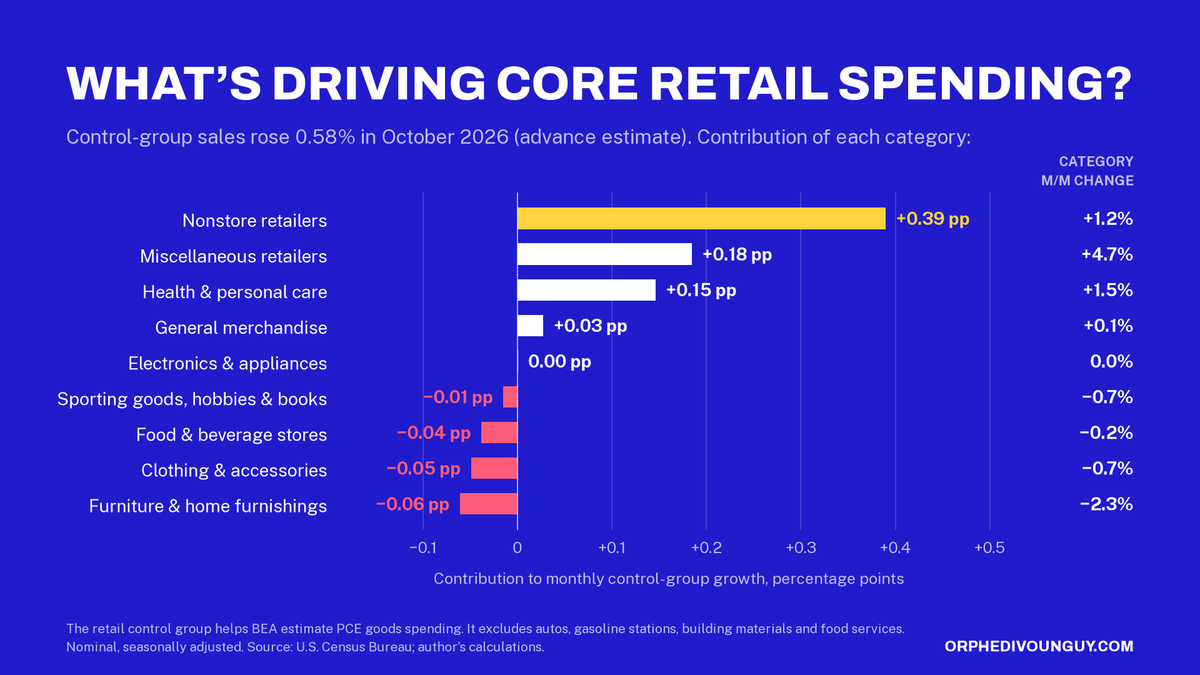
- Nonstore retailers drove the control-group gain. They supplied roughly two-thirds of the net increase in an indicator used to help estimate consumer goods spending.
What happened
According to the Census Bureau’s October advance report, retail and food services sales reached $748.2 billion, up 6.8% from a year earlier. September’s reported 0.8% monthly increase was unrevised. October’s estimated 0.2% gain was not statistically distinguishable from zero.
Motor vehicle and parts sales fell 1.6%. By my calculations, had auto sales held steady, total retail sales would have risen about 0.5% instead of 0.2%.
Gasoline-station receipts rose 1.5%, far less than September’s 6.0% jump. Had they provided the same boost as in September, total sales would have grown about 0.4 percentage point faster.
The slowdown in gasoline-station receipts is consistent with cooling gasoline inflation. According to the October CPI release, the seasonally adjusted gasoline index rose 1.0% after jumping 9.1% in September; before seasonal adjustment, pump prices fell 0.7%. Seasonally adjusted producer prices for gasoline rose 0.5% after a 20.6% surge in September. As I noted in my October inflation analysis, the gasoline shock eased sharply. Gas station receipts reflect prices, quantities and other merchandise sold; they do not measure gallons purchased.
The fading gasoline contribution accounted for more of the slowdown than the larger auto drag. Together, they explain nearly all the change. Excluding both categories, nominal sales rose 0.52%, following September’s 0.49%.
What matters for consumer spending
The retail control group—sales excluding autos, gasoline, building materials and food services—rose 0.58%, following September’s 0.53%. The Bureau of Economic Analysis uses these sales to help estimate goods spending in personal consumption expenditures.
Nonstore retailers, including online sellers, supplied the largest contribution:
| Category | October sales change | Contribution to control-group growth |
|---|---|---|
| Nonstore retailers | +1.24% | +0.39 percentage point |
| Miscellaneous retailers | +4.71% | +0.18 percentage point |
| Health and personal care | +1.48% | +0.15 percentage point |
The miscellaneous-retailer gain may be revised. Over the past 12 months, Census estimates of this category’s monthly growth have typically changed by about 0.9 percentage point after the advance report.
Declines elsewhere offset some of those gains. Furniture sales fell 2.3%, clothing declined 0.7%, food and beverage stores fell 0.2%, and sporting goods, hobbies and books declined 0.7%. General merchandise sales edged up 0.1%.
What it means
October offers limited evidence of broad consumer retrenchment. Nominal sales growth outside autos and gasoline held steady.
Adjusted for prices, sales were roughly flat. According to the October CPI release, overall consumer prices rose 0.4%. Using that as a rough adjustment, total retail sales slipped about 0.1%, while sales excluding autos and gasoline edged up about 0.2%.
Furniture’s decline and flat electronics sales made October softer for those businesses, although both remained above their levels three months earlier.
For the Fed, continued nominal spending growth offers little evidence of a broad pullback in demand. PCE will provide a fuller picture of real goods and services consumption.
Method note: Sales figures are adjusted for seasonal variation and holiday and trading-day differences. Headline CPI is an approximate deflator because it includes shelter and other services retailers do not sell. BEA converts retail sales to real spending by allocating purchases across product categories and applying category-specific price indexes, so the headline-CPI adjustment above is only a rough approximation. Real annual growth is omitted because BLS did not publish an October 2025 headline CPI index.