Can You Blame Gen Z for Being Skeptical About AI?

Key Takeaway
Young workers have reason to be skeptical, but the outcome is far from predetermined. Labor’s share tells us how the gains are divided; productivity tells us how large those gains are. The key question is whether AI raises output per worker enough to support higher real wages — especially if labor’s share is falling.
Something has shifted in how young Americans feel about artificial intelligence.
Gen Z is still using generative AI at high rates, but enthusiasm is fading. Gallup finds that roughly half of Gen Z uses generative AI at least weekly. Yet only 22 percent say they are excited about it, 18 percent say they are hopeful, and 31 percent say they are angry. Among employed Gen Zers, those who say the workplace risks of AI outweigh the benefits outnumber those who see the benefits as greater by more than three to one.
It is easy to dismiss that as technological pessimism. The economics gives them more reason to worry.
I built a model to ask a relatively simple question: what happens to workers, saving and interest rates as more of the economy’s capital becomes capable of doing work previously performed by people?
The first answer was intuitive. If agentic AI replaces labor, workers lose income share, wages fall and returns to capital rise.
The second answer was more surprising. Even when AI complements labor, wages can still fall. That sounds contradictory. That is because wages depend on both labor’s share of income and the size of the pie. A falling labor share can coexist with rising wages if productivity rises enough — and a rising labor share can coexist with falling wages if productivity falls.
The setup
The model is a standard life-cycle economy with overlapping generations. People enter the workforce around age 20, earn wages, consume and save during their careers, accumulate assets approaching retirement and then draw those assets down later in life.
Those savings finance firms’ productive capital and government debt. The interest rate adjusts until the assets households want to hold equal the assets the economy needs them to finance.
The production side builds on Joel Prakken’s agentic-capital framework — treating a portion of the capital stock as able to perform tasks previously done by workers — and the way that reshapes the return to capital. I take that production structure and embed it in a life-cycle economy, allowing agentic capital either to substitute for workers or to complement them. A fraction β of total capital is agentic:
KA = βK
The rest is non-agentic capital:
KN = (1 − β)K
In the model the share of agentic capital β is exogenous. In reality, firms decide how much agentic AI capital is needed to maximize profits.
I impose a higher agentic share β and allow the total capital stock, wages, saving, output and the interest rate to adjust in equilibrium. Firms do not separately choose agentic and non-agentic capital in response to their relative prices. That distinction matters for interpreting the wage result, and I return to it near the end.
Under a parsimonious calibration to U.S.-scale moments — a 6 percent equilibrium return, a 60 percent labor share, and standard life-cycle parameters — the model reproduces the features you would expect: a hump-shaped path of labor income, households smoothing consumption while building and then spending down wealth, and a capital–output ratio of 3.33.

What happens when the share of agentic capital increases?
A higher agentic share mechanically means a smaller non-agentic share. But then total capital is allowed to adjust in equilibrium.
For each production technology, I recalibrate the economy to exactly the same starting point: a 6 percent equilibrium interest rate, 60 percent labor share and capital–output ratio of 3.33. Then I raise the agentic share of capital β from 5 percent to 30 percent.

When AI replaces workers
Start with the easiest case. In the benchmark where agentic capital can perfectly replace labor, raising its share from 5 percent to 30 percent lowers labor’s share of income from 60 percent to about 51 percent. The real wage falls about 15 percent. The equilibrium interest rate rises from 6 percent to about 8 percent — roughly 200 basis points.
The result shrinks as agentic capital becomes a less effective substitute for labor. At an elasticity of 2, the increase is about 56 basis points. At 1.5, it is about 32 basis points.
The mechanism is straightforward. Agentic capital can now perform work previously constrained by labor. That raises demand for capital. At the same time, workers receive a smaller share of income. In a life-cycle economy that matters for saving, because households build much of their wealth out of wages. At the old interest rate, the smaller wage base leaves households wanting to hold fewer assets while firms want more capital. The interest rate rises until the asset market clears.

Complementarity does not guarantee higher wages
Complementarity changes the factor-share result, but it does not by itself determine the wage.
With an elasticity of 0.5, raising the agentic share from 5 percent to 30 percent increases labor’s share from 60.0 percent to about 61.6 percent and lowers the equilibrium interest rate from 6.0 percent to about 5.65 percent. Yet the real wage falls about 13 percent.
The reason is the wage identity:
w = θ · (Y/L)
Labor receives a larger share θ, but output per worker Y/L falls by about 15.5 percent. The productivity decline is larger than the increase in labor’s share. A larger share of a smaller pie can still leave you worse off.
Why output per worker falls
The first equilibrium response is that aggregate capital per worker falls. In the complement calibration, K/L falls by roughly 16 percent — this is the endogenous general-equilibrium response, not something imposed by hand. Because the agentic share is simultaneously rising, the non-agentic component of that smaller capital stock falls even more sharply. The model therefore ends up with much more agentic capital but substantially less total capital per worker, and much less non-agentic capital per worker.
| Outcome | Baseline | β = 30% |
|---|---|---|
| Aggregate capital per worker, K/L | 6.61 | 5.53 (−16%) |
| Non-agentic capital per worker, KN/L | 6.28 | 3.87 (−38%) |
| Agentic capital per worker, KA/L | 0.33 | 1.66 (×5) |
| Labor share, θ | 0.600 | 0.616 |
| Output per worker, Y/L | — | −15.5% |
| Real wage, w | — | −13.2% |
| Equilibrium interest rate | 6.00% | 5.65% |
Holding the other productive inputs fixed, complementary agentic capital raises labor’s marginal product. But in equilibrium, aggregate capital per worker falls, while the non-agentic share of that capital stock is also shrinking. Together those forces overwhelm the direct complementarity effect, so output per worker and the real wage fall.
What this exercise does not tell us
There is another possible path for AI diffusion. If agentic capital becomes cheaper, firms may choose the optimal allocation of agentic and non-agentic capital. In such a model, KA and KN could both rise. In an even richer task model, workers displaced from some activities could be re-employed alongside non-agentic capital elsewhere.
In that world, the wage need not fall. If output per worker rises by more than the decline in labor’s share θ, then by w = θ(Y/L) the wage rises.
What happens to young workers?
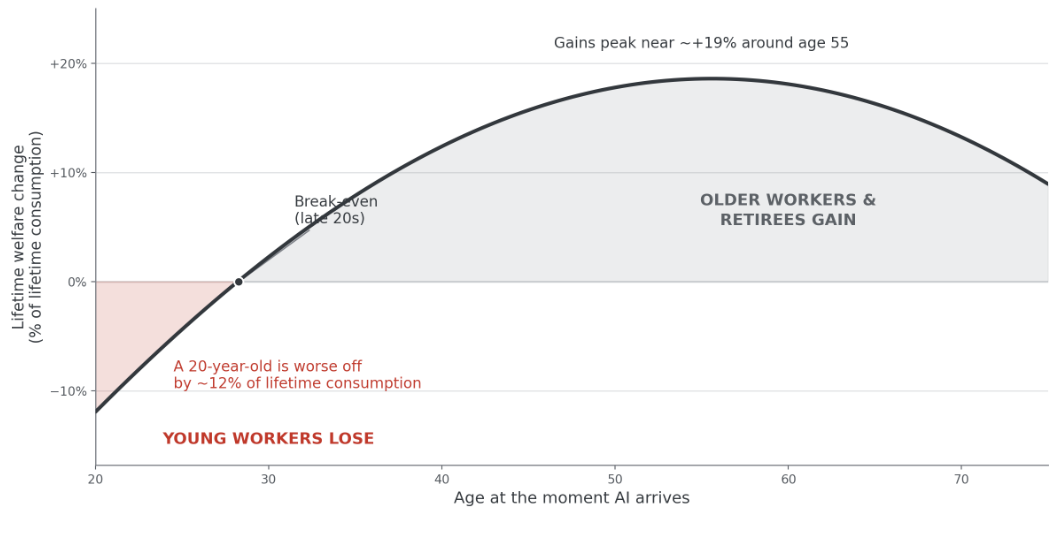
I also solve a transition in which labor-replacing agentic AI arrives suddenly and the economy moves toward its new steady state. That exercise gives a clear age split when AI substitutes for labor.
A household that is 20 when AI arrives loses about 12 percent of lifetime consumption. The break-even age is around 28. Gains peak around age 55 at roughly 19 percent, and households around retirement age remain better off. Young households have most of their working lives ahead of them and relatively few assets: they are exposed to the lower wage path but own little of the capital earning the higher return. Older households are the reverse. Because the capital stock cannot jump immediately, the return initially overshoots as the economy adjusts, which particularly benefits existing asset owners.

So, can we dismiss Gen Z’s anxiety?
The question is not simply whether AI substitutes for or complements workers. It is also what happens to productivity as firms adopt it. Labor’s share tells us how the pie is divided. Output per worker tells us how large the pie is. Wages depend on both.
In my current experiment, a higher agentic share changes the composition of an endogenous capital stock. Under strong complementarity, aggregate capital per worker falls, output per worker falls, and wages fall even though labor receives a larger share of income.
But that is not the only possible adoption path. If cheaper agentic capital causes firms to add productive capacity and re-employ displaced workers alongside other capital, output per worker could rise enough for wages to rise even while labor’s share falls.
Today’s lesson is narrower: substitution versus complementarity is not enough to infer what happens to workers’ real wages as agentic AI spreads.
The genuinely useful question for workers is whether AI adoption ultimately raises output per worker enough to generate wage gains, and how those productivity gains are divided.