Fewer New Single-Family Homes Are Coming to Market


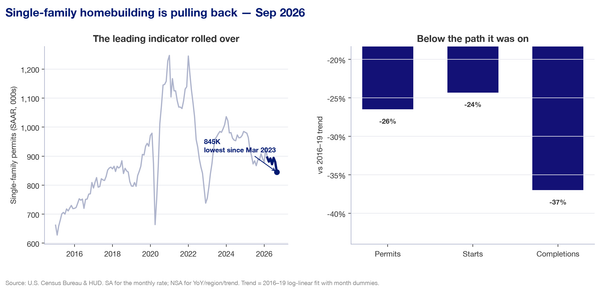
New-home supply is set to fall sharply in 2026. The biggest pullbacks are happening in some of the markets that spent the past few years working through an inventory glut.
The housing market has spent the past few years working through too much inventory in many of the places where builders were most aggressive.
That may finally be starting to change.
Our estimates suggest single-family completions will fall sharply across most major homebuilding markets in 2026. Among the 40 largest single-family construction markets in our dataset, only two are expected to deliver more homes than they did in 2025.
North Port–Sarasota–Bradenton is essentially flat, up roughly 2%. Kansas City is up approximately 1%.
Everywhere else, the direction is down.
And some of the biggest pullbacks are happening precisely where supply has been heaviest.
Where homebuilding is pulling back fastest
Among the 40 largest markets by expected 2026 single-family completions, the five largest declines are:
- Charlotte: roughly −25%
- Las Vegas: roughly −25%
- Cape Coral–Fort Myers: approximately −24%
- Jacksonville: approximately −24%
- Orlando: about −22%
That is a meaningful shift in the supply picture.
Today’s glut can become tomorrow’s shortage
There is an important difference between too much inventory today and too much construction going forward.
Several Sun Belt markets still carry elevated inventories because homes built during the previous boom have taken longer to absorb. High mortgage rates made that adjustment harder.
Builders responded the way we would expect: incentives increased, prices adjusted and construction slowed.
But construction works with a lag. The homes being completed today were permitted and started months ago. By the time slowing starts show up in completed-home inventory, builders have already changed course.
That means the markets that look weakest today can be the ones approaching an inflection point.
Prices don’t need booming demand to firm
This doesn’t mean Charlotte, Las Vegas, Cape Coral, Jacksonville or Orlando are headed for another boom.
Demand still matters enormously. Mortgage rates remain high, affordability is stretched and the national market has softened again.
But prices are set by both sides of the market. If demand merely stabilizes while substantially fewer new homes arrive, builders have less inventory to clear. Incentives can shrink. Price cuts become less necessary. Existing owners face less competition from discounted new construction.
That’s why I’d expect price conditions to firm first where the supply correction is largest.
What about 2027?
The early pipeline points toward another leg down in single-family supply, but it is too early to put precise metro rankings on 2027.
A meaningful share of the homes that will ultimately be completed in 2027 has not yet entered the permit data. The more useful signal right now is that the pipeline feeding future completions has become much thinner.
If permits and starts stay depressed through the rest of 2026, today’s oversupplied markets could look considerably different a year from now.
That’s the part of the housing correction I think the market is underestimating.
Today’s inventory tells us where housing supply is. The construction pipeline tells us where it is going.
How we estimate future completions
The Census Bureau publishes detailed building-permit data for metropolitan areas but does not publish comparable metro-level completion estimates. Quantitative Research Group estimates future metro completions by combining Census permit histories with the observed timing between authorization and completion in national construction data. The model estimates single-family and multifamily construction separately, accounts for projects that do not ultimately become completed units, and is tested against periods not used to fit it. The 2026 figures represent the supply implied by the construction pipeline observed to date rather than a simple count of permits. Comparisons are limited to sizable construction markets to reduce distortions from very small bases.