Why have mortgage spreads widened since mid-September?

Key Takeaways
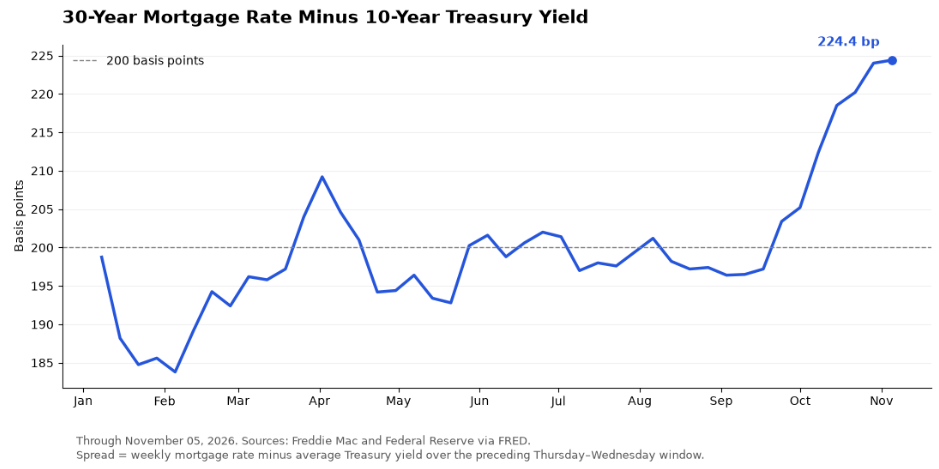
- Volatility explains only part of the widening. The gap between mortgage rates and the 10-year Treasury yield grew about 27 basis points between September 17 and November 5. Our models tie roughly 7–8 basis points of that to higher volatility and yield-curve changes.
- Investors pulled back from mortgage bonds. Hedge funds and investors hedging mortgage-servicing rights reduced their exposure in September, adding selling pressure.
- Falling Treasury yields reached borrowers only partly. Since October 8, mortgage rates have fallen 22 basis points while matched Treasury yields fell about 34. Slower pass-through or higher lending costs could explain the gap, but neither is established.
Greater interest-rate uncertainty and selling pressure in mortgage bonds appear to have contributed. Later, mortgage rates fell more slowly than Treasury yields. Slower pass-through to borrowers or higher lending costs could help explain that later widening, but we haven’t established either.
The mortgage spread is the gap between the average 30-year mortgage rate and the 10-year Treasury yield. Between September 17 and November 5, it widened about 27 basis points, or 0.27 percentage points.
Here’s what the evidence shows.
1. Interest-rate volatility increased as the widening began
Between August 27 and September 17, mortgage rates and Treasury yields rose by almost equal amounts, leaving the spread essentially unchanged.
Between September 17 and October 8, mortgage rates rose 45 basis points while matched Treasury yields rose about 30. The spread widened 15 basis points as daily Treasury yield swings increased.
Annaly Capital, a company that invests in mortgage bonds, also reported increases in both realized volatility and market expectations of future volatility during September.
Using relationships estimated before the widening began, our models associate changes in volatility and the yield curve with roughly 7–8 basis points of the subsequent 27-basis-point increase. That supports a partial explanation, while leaving about 19–20 basis points unexplained.
2. Investors reduced their exposure to mortgage bonds
Dynex Capital, another mortgage-bond investor, reported that hedge funds reduced their exposure and investors hedging mortgage-servicing rights were net sellers. Agency mortgage-bond spreads widened 10–20 basis points, particularly late in the third quarter, while new mortgage origination supply remained muted.
There were buyers too. Dynex reported that money managers remained net buyers and saw indications that Fannie Mae and Freddie Mac resumed purchases late in the quarter.
That supports selling and hedging pressure as contributors to September’s widening. It does not tell us precisely how much those transactions moved rates, and those pressures may themselves have reflected greater uncertainty.
3. Falling Treasury yields reached borrowers only partly
Between October 8 and November 5, matched Treasury yields fell about 34 basis points, but mortgage rates fell only 22. The spread widened another 12 basis points.
AGNC Investment Corp., a company that invests in mortgage bonds, reported that mortgage-bond spreads to its benchmarks were essentially unchanged over October. Meanwhile, our measured gap between borrower mortgage rates and the 10-year Treasury continued widening.
That raises the possibility of slower pass-through to borrowers or higher costs to originate and hedge loans. But AGNC uses different benchmarks and measurement dates, so we need a consistent comparison before assigning responsibility. Weak mortgage activity also makes an explanation based on overwhelmed lenders less convincing.
Wider spreads have limited borrowers’ benefit from falling Treasury yields. They have not prevented mortgage rates from declining: Freddie Mac’s average fell from 7.40% to 7.18% between its October 8 and November 5 surveys.
Data and calculations: Freddie Mac mortgage rates and Federal Reserve Treasury yields via FRED; author calculations. Treasury yields are averaged over each mortgage survey’s Thursday–Wednesday collection window. Yield-curve calculations also use the 2-year Treasury yield.