October 2026: Job growth strengthened. Are employers committing—or keeping their options open?

What happened?
- Employers added 165,000 jobs, and unemployment edged down to 4.1% from 4.2%. August and September gains were revised up by 84,000 combined, bringing three-month average job growth to 137,000.
- Hourly earnings rose 0.4%, bringing annual growth to 3.1%, versus 3.0% in September.
- Participation was roughly flat at 61.9%, versus 61.8%. The employment-to-population ratio told the same story: 59.3%, versus 59.2%.
Where was the strength?
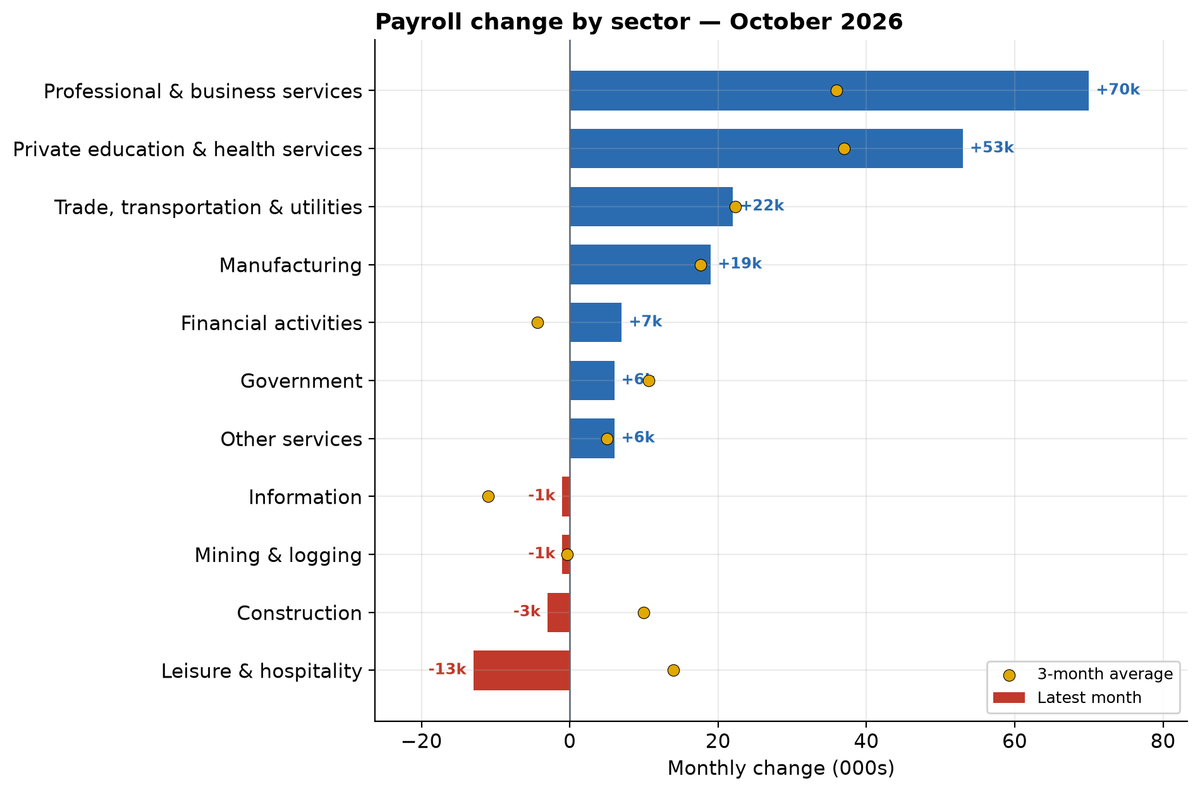
- Professional and business services added 70,000 jobs—the biggest monthly gain since July 2022, compared with 8,000 in September and a July–September average of about 10,700.
- Temporary help, consulting and company management drove the acceleration, adding 18,600, 17,300 and 8,700 jobs, respectively. Together, they supplied about 64% of business-services gains.
- Computer systems design added 3,200 after three monthly declines. Architecture and engineering added 4,900, below its recent pace.
- Health care added 42,000, transportation and warehousing 25,000, and manufacturing 19,000.
Will those gains repeat?
- Temporary staffing can precede permanent hiring. But does October signal stronger underlying demand, or an earlier holiday staffing buildup? Normal holiday hiring is already removed by seasonal adjustment; changes in timing can still affect the result.
- Consulting growth could signal expansion—or companies purchasing expertise for specific projects while holding back on permanent hires. The report cannot distinguish those explanations.
Where was the weakness?
- Involuntary part-time employment increased 339,000 to 4.8 million.
- Long-term unemployment represented 27.6% of unemployment, up from 27.1% in September, although the number of long-term unemployed was little changed.
My view: Stronger job growth and upward revisions are encouraging. But temporary staffing and consulting accounted for about half of the business-services surge, leaving open whether that pace will persist. Rising involuntary part-time work and elevated long-term unemployment reinforce my caution about calling this a sustained acceleration.